In short, the virtual worlds paradigm is an also-ran in the marketplace and there is no indication of a significant positive change for the foreseeable future. That's why my optimism is for the future we can't foresee, which will be the focus of the concluding post in this series. Second Life vs. The World.
Before I play Nostradamus and try to predict the unforeseeable future, I want to reply to those who disagreed about my assessment of the present and near future.
A number of people mentioned the
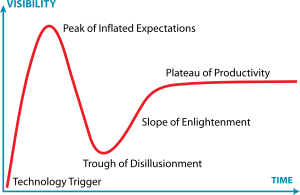
Gartner Hype Cycle which tracks new technologies through what Gartner sees as a predictable life-cycle.
Inara Pey and
Dale Innis both proposed that virtual worlds are in the "Trough of Disillusionment":
As it stands, Gartner see VWs only now starting to climb out of the "Trough of Disillusionment" which results from the period of over-inflated hype about a new product. Further, they place the emergence of VWs as a widely-adopted, productive technology as still being 5-10 years hence. Inara Pey in a comment
I took at look at a few of Gartner's most recent reports and I thought they painted a much less positive picture for the future. They report declining interest in education, the consumer space and the business market, with no prediction of significant success in the future:
Without a clear audience value proposition across multiple age groups and sectors, early interest in social worlds has declined . . . . In the short term, virtual worlds remain a "sandbox" environment for experimentation in training, community outreach and collaboration, but the buzz has died, and enterprise interest remains static. In the longer term, virtual environments still represent useful media channels to support and engage with communities in an immersive fashion, but they appear unlikely to induce transformational change. Gartner Hype Cycle for Emerging Technologies, 2012
This series of posts
began by asking if our virtual world dream was over. I think Gartner's phrase,
transformational change, is a good description of the hopes we had for virtual worlds. We didn't see Second Life as just a place for us to hang out and enjoy ourselves. Many of us believed that virtual worlds would eventually have a tangible positive influence on our overall society by empowering personal expression and creativity, promoting tolerance and diversity, providing a global marketplace providing economic opportunities, etc.
I still believe in that vision because I've personally experienced the virtual world's potential to actualize such lofty aims on the small scale. But I don't see any clear path to wider acceptance. Second Life, the 1000 pound Gorilla in the virtual worlds market space, is a long shot. Their technological platform is ten years old and riddled with technical debt. Their brand is more associated with flying penises and cross-gender affairs than as a credible platform for the general public. Linden Lab's R&D is focused on other products rather than pushing Second Life to the next level.
I think OpenSim providers have a great opportunity over the next few years to capture significant segments of Second Life's customer base, especially companies like
Inworldz who are investing in moving the technology forward. Their main challenge is in wooing enough content creators to create a robust marketplace. But I don't think OpenSim has any better prospects than Second Life for breaking into general use, since the product, even with improvement, is just a clone of Second Life.
There are a number of business oriented vendors that provide 3D meeting and exhibit spaces, such as
Altadyn and
VenueGen. Although there are niche markets for those services, their value proposition isn't that compelling in relation to 2D solutions such as GoToMeeting.
Finally, there are a few emerging general use platforms such as
Jibe and
Cloud Party. It will be interesting to see how they evolve, since they are not tied to kludgy legacy code or change-resistant user communities. The challenge is that we still haven't found that compelling use case . . . the killer app . . . which will open up the public's eyes to the power of the virtual world paradigm. Although I have no idea what that magic idea will be, I have a few idea of how we might get there:
- Developing iteratively with active user participation. Using an agile approach, the direction of a product is guided by the emergent priorities and requirements of engaged users. The only way to end up with a product that is better than we can initially imagine, is to move forward in collaboration with both the customer and the emerging product itself. I've seen this time and time again in products my company has built for corporate customers.
- Focusing on providing a compelling solution to a specific audience for a specific purpose. There's currently too much attention on product features and technology instead of creating compelling solutions for specific use cases and clearly defined user groups.
- Creating an Open Services platform that encourages other players to add value. Second Life took this approach to a limited extend by allowing people to create and sell content on their platform. But they've turned away from supporting third party viewers, interoperability between grids and third-party marketplaces.`I would love to see Cloud Party or Jibe create open APIs that allow third party applications to easily integrate with their platforms.
So that's my Nostradamus act for today. It's been interesting thinking about this stuff again and I appreciate everyone's comments and the ongoing discussion.